Seeds or Young Plants: Which Start Fits Your Patch?
Seeds or young plants: match each to your time, variety choices and available starting space, then plan a calm route from packet to patch.
The common mistake with seeds or young plants is choosing one method for the whole garden before checking where each plant will actually start. That can cost you a windowsill crowded with trays, or a planting gap where a crop was meant to be. A better choice follows the plant’s needs and the space you can spare.
Seeds or young plants depend on your starting space
Sowing seeds means you provide the germination conditions and care for small seedlings before they go outside. Buying young plants shifts that early work to a grower: you receive something already established enough to plant, though it still needs settling-in care.
Seeds suit a patch with a sheltered place for trays, such as a bright windowsill, a cold frame or a greenhouse shelf. The place need not be elaborate, but it should be somewhere you can check regularly and where trays will not be knocked, dried out or forgotten behind a curtain. A windowsill already occupied by household life is not spare growing space merely because it has a flat surface.
Young plants make sense when there is room in the bed but little room indoors. They can also help if your suitable sowing window has passed, or if you want a modest number of plants without keeping a tray for a small remainder. Their convenience has limits: you still need to collect them, keep them in reasonable condition and plant them promptly.
Match the method to the variety you want
Seed catalogues and packets often offer varieties that are harder to find as young plants. This matters if you want a particular colour, flavour, growth habit or crop suited to your cooking. Sowing broadens the menu, but a long list of tempting packets can become a collection of obligations with little connection to the size of the patch.
Young plants usually offer a more restricted selection, yet they are often the straightforward choice for familiar varieties sold locally. You can inspect their condition before buying: look for sturdy stems, healthy leaves and roots that have not formed a dense, tangled mass at the base of the pot. Avoid plants with obvious damage or signs of stress.
Some plants are commonly sown where they will grow, while others are often started under cover and planted out later. The packet or supplier’s instructions are the useful guide here; follow them for sowing depth, timing and planting conditions. Local rules or manufacturer instructions can matter for particular products, so check the relevant label rather than improvising.
Use a week to decide what to start
Give the decision a short routine instead of buying first and finding space afterwards. This is not a schedule tied to a particular month: the right timing varies with the plant and local conditions.
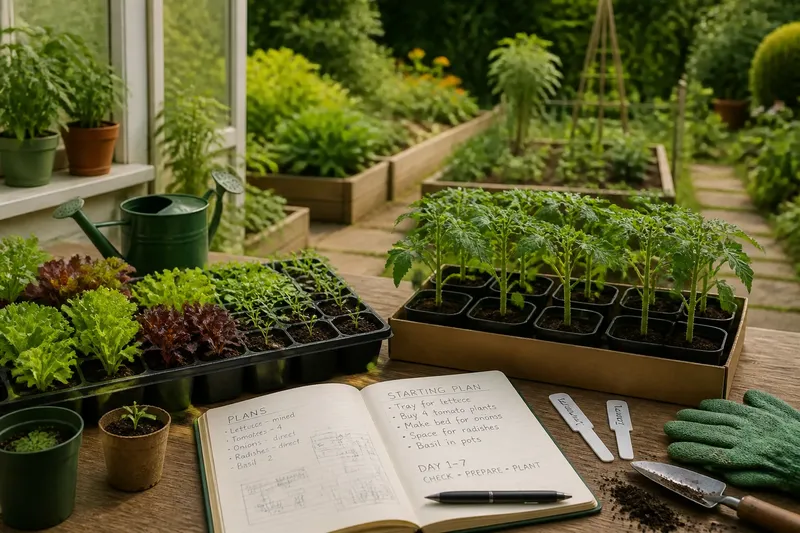
- Day one: List the plants you genuinely want, then note which varieties are essential and which are interchangeable.
- Day two: Check each plant’s packet or supplier guidance for whether it is sown in place, started under cover or planted as a young plant.
- Day three: Set out the trays, pots or sheltered space you can actually use. Count only places where you can reach and check the plants without shifting everything else.
- Day four: Match each planned sowing to a tray or patch. If there is no suitable starting place, choose a young plant or leave that variety for another season.
- Day five: Decide which young plants you can collect and plant without leaving them waiting around. Buy only what has a clear place in the bed.
- Day six: Prepare the required pots, seed compost, labels and watering can for the sowings you chose. Keep the number of trays manageable.
- Day seven: Sow or collect plants according to their guidance, then write the variety and sowing or planting date on a label.
Say you have a small patch, one free windowsill and want several kinds of lettuce alongside a few tomato plants. You might sow lettuce varieties in a compact tray, where variety choice matters and the seedlings do not demand a large starting area, then buy a small number of tomato plants if their indoor start would crowd out the tray. The observable result to look for is a clear place for each plant, rather than a queue of pots waiting for an empty surface.
Keep the first week after planting modest
Seedlings and purchased plants both need attention after planting, but they arrive at that point in different condition. A seedling raised in a sheltered spot may need gradual exposure to outdoor conditions before planting; this hardening-off period helps it adjust. A bought plant may also have been kept under cover, so ask how it has been grown and avoid treating its shop display as proof that it is ready for every outdoor condition.
After planting, check the soil around the roots and water when it needs settling in, rather than following a fixed routine regardless of weather or soil condition. Watch for wilting, loosened roots or damage from wind and pests. The point is not to hover; it is to notice whether a plant has settled and respond to what is actually there.
One thing is not worth the effort: sowing every seed in a packet “just in case”. Extra seedlings need pots, space and a destination, while many packets contain more than a small patch can use. Sow a manageable amount and keep any remaining seed as directed on its packet.
Which start suits the space you have?
Are seeds cheaper than young plants?
A packet may provide more plants than buying them individually, but the total effort and materials also matter. Compare what you can use with the trays, compost and sheltered space you already have rather than assuming the packet is automatically the economical choice.
Can I sow seeds directly into the garden?
Some plants are suited to direct sowing, while others are commonly started under cover. Check the plant’s instructions and choose a suitable place in the patch; direct sowing avoids trays but does not remove the need to keep the sowing area in good condition.
When should I buy young plants?
Buy them when the planting conditions suit the plant and you have a prepared place for them. If the bed is not ready or the weather is unsuitable, waiting is usually more sensible than bringing plants home to sit in their pots.
Can I mix seeds and young plants in one patch?
Yes. Use seeds for varieties you especially want or plants that fit your available starting space, and buy young plants where an early indoor stage would be inconvenient. The choice can differ from one crop to the next.
For seeds or young plants, the useful question is not which method is best in general, but which one gives each variety a workable start in the space you have. Make that decision before sowing or shopping, and the patch is less likely to inherit a surplus of seedlings or an empty space waiting for them.