What Garden Soil Is Made Of, and Why Texture Matters
Garden soil texture affects drainage, root space and how a bed feels to work. Learn what soil contains and how a simple feel-and-look check reads it.
The common mistake with garden soil is calling it “good” or “bad” after one glance at the surface. That can lead to needless digging, amendments that do not suit the bed, and plants chosen for a soil that exists only in the gardener’s imagination. Garden soil texture is a more useful starting point: it describes the relative amounts of mineral particles of different sizes, and helps explain how air and water move through the soil.
Imagine a hypothetical new gardener, Rowan, looking at a patch beside a shed. The surface is pale and crusted in one corner, dark and crumbly in another. Rather than treat those appearances as a diagnosis, Rowan takes a small sample from each area and checks how the soil looks and feels. The point is not to assign the whole garden a permanent label. It is to notice what the soil is made of, and what that arrangement may mean for roots.
Soil is a mixture, not a single material
Most garden soil contains mineral particles, organic matter, water and air. Their proportions vary from place to place and change with weather, cultivation and the addition of compost or other materials. Living organisms also inhabit the soil, but the basic texture description concerns the mineral particles: sand, silt and clay.
Sand has the largest particles of the three. They are usually visible as separate grains and feel gritty between the fingers. Silt particles are finer, often feeling smooth or floury when dry and slippery when damp. Clay particles are extremely fine; when moist, clay-rich soil can feel sticky and may hold together in a ribbon when pressed.
Most beds contain a mixture rather than a pure type. “Loam” is a familiar description for a balanced mixture of sand, silt and clay, but it is not a synonym for any soil that looks dark or pleasant. Colour can offer clues about organic matter and drainage, yet it cannot identify texture by itself.
Texture shapes the spaces between particles
Roots do not grow through mineral grains alone. They use the gaps between them, where air and water are held or move. Coarser, sandy soil tends to have larger gaps, so water can pass through readily and the soil may dry sooner. Fine clay particles pack into small spaces; clay-rich soil can retain water, while drainage and aeration may be slower, especially if the soil is compacted.
Silt sits between those extremes in particle size, though real garden beds rarely behave as tidy textbook mixtures. Structure matters too. A soil with crumbs and stable aggregates has connected spaces that can admit air and water. Compaction, repeated working when wet, or bare ground exposed to hard rain can damage those spaces, whatever the texture.
Organic matter is decomposed plant and animal material, including the humus that contributes to dark, crumbly soil. It can help bind particles into aggregates and support soil organisms. It is not a fourth mineral particle, nor does a dark colour prove that a bed contains enough of it. Air and water occupy the spaces between particles and aggregates; their share changes as soil wets, drains and dries.
Rowan checks two samples before making a decision
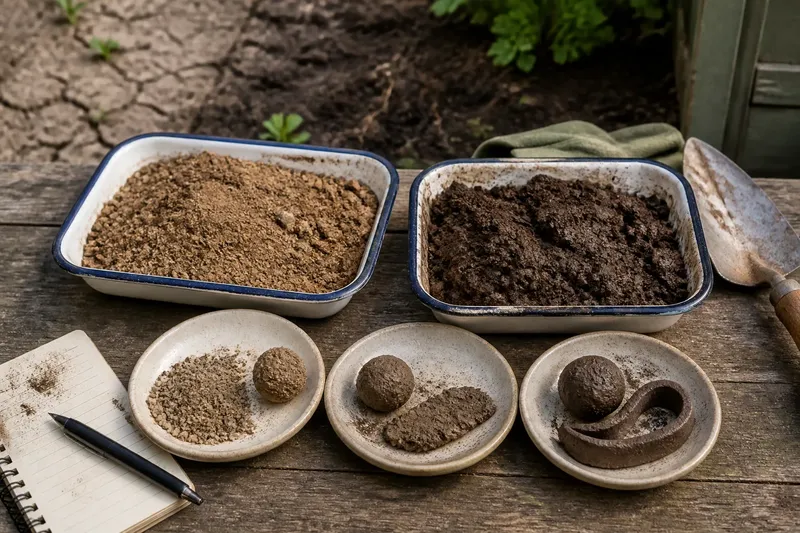
Say Rowan takes a handful of slightly moist soil from each corner of the patch, avoiding the surface litter. The first sample feels gritty and falls apart when gently squeezed. Rowan notes that it seems sandy, but does not decide that the entire bed needs compost. In the second sample, the soil feels smooth and forms a short, sticky ribbon before breaking. Rowan records that it is likely to contain more clay.
For a simple feel-and-look check, crumble a small sample and remove stones, roots and visible plant debris. Rub a pinch between finger and thumb, then add a little water until it is damp enough to mould but not wet enough to smear freely. Notice whether it feels gritty, smooth or sticky. Try pressing it into a ball, then a ribbon; observe whether it holds together and how readily it breaks.
- Gritty grains that do not hold together suggest a higher sand content.
- A smooth, floury feel suggests more silt.
- Sticky soil that moulds readily and forms a longer ribbon suggests more clay.
- A sample that holds a loose ball but breaks with gentle pressure may contain a mix of particle sizes.
This is a rough field check, not a laboratory classification. Rowan repeats it in several parts of the patch because one corner’s fill, foot traffic or past planting may have left it different from the rest. The useful result is a set of observations tied to locations, not a single grand verdict on the garden.
Look at the soil’s condition as well as its texture
After the feel check, Rowan examines the samples. Are there crumbs or hard clods? Are roots and small channels visible? Does the soil smell earthy, or is it sour and stagnant? These details describe structure and condition, which texture alone cannot settle. A clay-rich bed can be well structured; a sandy one can still be compacted or poor in organic matter.
Rowan also notices that the crusted corner has little plant cover and a hard surface, while the darker corner contains old roots and loose crumbs. That difference might reflect management or recent weather rather than an entirely different underlying soil. A gardener should avoid treating every visible contrast as a reason to dig in a product. Observe the bed again under ordinary conditions and note where the same pattern recurs.
For a closer look at the soil profile, Rowan uses a hand trowel to lift a small slice from an unobtrusive spot. The upper layer may contain more organic material and fine roots; below it, the colour, density or particle mix may change. Replacing the slice afterwards leaves the patch largely undisturbed and makes the observation more useful than scraping at the surface alone.
What does a feel-and-look check tell you?
Can you identify exact soil texture by touch?
Touch can suggest whether sand, silt or clay is more prominent, but it does not provide a precise laboratory classification. Treat the result as a practical description and compare samples from different spots.
Does dark soil mean the bed is rich in organic matter?
Dark colour can be associated with organic matter, but colour is not a reliable measure of its amount or quality. Look at crumbs, roots and the soil’s behaviour as well as its appearance.
Is clay soil always poorly drained?
No. Clay content can slow water movement, but structure, compaction, slope and the soil below the surface also matter. A well-aggregated clay soil can behave differently from a compacted one.
Should you amend soil as soon as you identify its texture?
Not necessarily. First decide what the observation means for the plants and the work planned for that particular bed. Advice that depends on a product label, manufacturer’s instructions or local rules should follow those directions.
Rowan’s notes lead to a smaller, clearer next move
Rowan’s samples suggest two textures and different surface conditions, but neither calls for a dramatic rescue. The gardener marks the observations on a rough sketch: gritty soil near the shed, stickier soil by the fence, and a crusted surface in the exposed corner. The next decision can then be made for the relevant spot rather than for an imagined uniform plot.
What is not worth the effort is repeatedly squeezing samples until every handful earns a confident label. Garden soil varies, and a home check is meant to guide attention, not certify a bed. Nor is it useful to judge texture from a single dry clod, which may crumble or harden in ways that hide how it behaves when damp.
In Rowan’s hypothetical situation, the result is not a transformed patch but a more accurate working picture: mineral texture differs across the bed, organic matter and structure affect the spaces within it, and surface appearance alone tells only part of the story. A simple feel-and-look check gives the gardener language for those differences. Keep the notes with the locations, and revisit them when making a decision about that soil; garden soil texture is most helpful when it describes the ground actually under consideration.